
- Client: High-net-worth professional with complex income structure
- Challenge: Securing 90% loan-to-value finance on a high-value residential purchase
- Loan Amount: Circa £2.5M mortgage at 90% loan-to-value
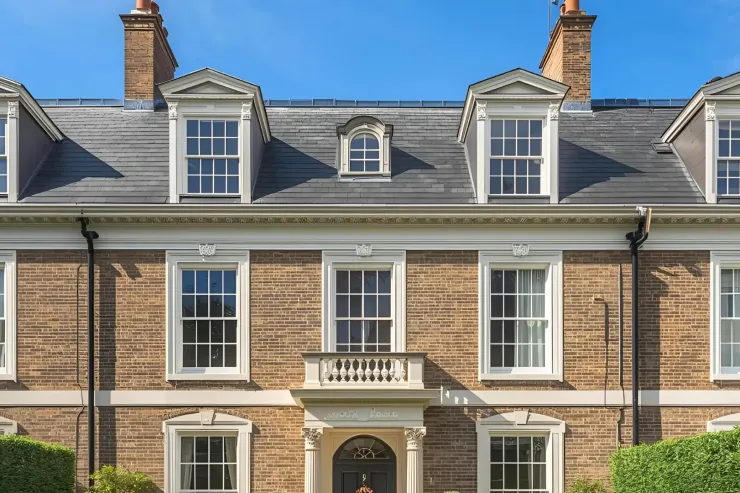
A high-net-worth client approached Enness seeking finance to purchase their existing rented home, a residential property valued at circa £2.8M. The client had built a 10% deposit and was keen to secure the property immediately rather than continuing to rent while saving for a larger deposit.
Despite the client's strong earnings and excellent financial profile, the transaction presented several challenges from a conventional lending perspective. The primary obstacle was the high loan-to-value requirement. At 90% loan-to-value and with borrowing exceeding £2M, the case sat well outside the appetite of most mainstream lenders.
Many high-street lenders significantly reduce maximum loan-to-value ratios as loan sizes increase, particularly on residential mortgages above £1M. This substantially narrowed the pool of lenders willing to consider the transaction.
The client's income structure added a further layer of complexity. A significant proportion of earnings came from performance-based bonuses, supported by a strong track record of year-on-year growth. In addition, part of the client's income was denominated in US dollars, which many lenders were unwilling or unable to fully incorporate into affordability assessments.
As a result, traditional lending models failed to reflect the client's true earning capacity and long-term financial strength.
Enness undertook a targeted review of specialist lenders and private banking institutions capable of assessing the client's profile holistically. Rather than relying solely on standard affordability metrics, the selected lender took a broader view of the client's financial position, including earnings trajectory, bonus history and future income potential.
A bespoke mortgage facility of circa £2.5M was arranged at 90% loan-to-value through a private bank. The mortgage was structured with a combination of interest-only and capital repayment elements, creating an efficient balance between lower monthly payments and long-term capital reduction.
Importantly, the structure also allowed the client to make penalty-free overpayments using surplus income, providing flexibility to reduce the mortgage balance more quickly as earnings continued to increase.
This case demonstrates how high-value, high loan-to-value borrowing often requires specialist structuring and lender access beyond the mainstream market. By understanding the client's broader financial profile and future earning potential, Enness secured a tailored solution that enabled the purchase to proceed on highly competitive terms.
Information contained in our case studies is for market and illustrative purposes only. In some cases, these may be made up of multiple cases and are for illustrative purposes only.
Some case studies are made up of enquiries that have come into the business, not all business completes, and the posting of a case study does not represent a completed piece of business.
Property values can fall as well as rise, and you may not get back the amount originally invested. Property investments can be illiquid and may take time to sell. Where borrowing is used, your property may be repossessed if you do not keep up repayments on a mortgage or other loan secured against it.