Why do Ultra-High-Net-Worth Individuals Still Need a Mortgage to Buy a Home?
11th Jun 24 · Last updated 24th Sep 26 · 8 MIN READA large mortgage, or borrowing when you could pay cash, is a residential loan of £1 million or more assessed on the borrower’s whole balance sheet rather than a salary multiple. Most ultra-high-net-worth buyers borrow to keep capital invested and liquid. Enness Global arranges them; this post is for borrowers and advisers weighing cash against a mortgage, as of 2026.
Your home may be repossessed if you do not keep up repayments on your mortgage.
Cross-border borrowing may involve additional legal, tax, regulatory and currency considerations, and independent professional advice should be sought where appropriate.

Key terms
- Ultra-high-net-worth individual (UHNWI): often described as someone with a net worth of at least US$30 million; Enness Global treats loans of £10 million and above as ultra-high-net-worth cases.
- Super prime property: in London, a home priced at £10 million and above.
- Large mortgage: a residential loan of £1 million or more, underwritten case by case rather than through an automated affordability model.
- Interest-only mortgage: only the interest is paid during the term; the capital is repaid at the end from an agreed strategy.
Do rich people have mortgages?
Yes, many do, by choice rather than necessity. Wealthy individuals don’t need a mortgage in the same way as the rest of the market operates. A first time buyer needs a mortgage to buy a £500,000 property because they don’t have £500,000. They have five or ten per cent as a deposit, saved up or gifted to them by a family member, and the mortgage is a necessity that lets them spread the cost of that purchase over 25 or 30 years.
An ultra-high-net-worth individual buying a £20 million or £30 million property may be in the same situation, but they might choose to take a mortgage. It might let them stretch up into a higher bracket, preserve liquidity to refurbish the property, or buy before a liquidity event like a company sale or an inheritance. Or borrowing at market rates in the UK or Europe might be more efficient than distributing cash from a company, breaking investments or selling other assets.
There are just over 600,000 ultra-high-net-worth individuals worldwide, commonly defined as people with a net worth of US$30 million or more (Knight Frank, The Wealth Report, March 2024). They own the world’s most expensive homes, and they are a segment Enness Global has served since 2007. In London, super prime means a home priced at £10 million and above, the top of the market by value.
Why does a mortgage for the wealthy look nothing like a normal one?
A standard mortgage is assessed on income and a fixed affordability multiple. A large mortgage is assessed on the borrower’s wider financial position: income that may be irregular, earned abroad or tied to a business, alongside investments, property and other assets that sit outside a savings account. The lender types differ too, which is why most of these loans are arranged through a broker.
| Feature | Standard residential mortgage | UHNW or large mortgage |
|---|---|---|
| Basis of lending | Income and affordability | Wider financial position, including assets and investments |
| Typical structure | Capital repayment | Interest-only or capital repayment, depending on circumstances |
| Security | Usually the property | The property and, where appropriate, additional eligible assets |
| Loan size | Varies by lender and borrower | Substantially larger in many cases, subject to lender criteria |
| Where it is arranged | High street banks and mortgage lenders | Private banks and specialist lenders, often through a broker |
In practice these facilities include large mortgages of £1 million or more, million pound mortgages and complex mortgages, depending on the borrower’s circumstances.
For some borrowers an interest-only mortgage keeps monthly commitments low and preserves liquidity, provided there is an agreed strategy for repaying the capital at the end of the term. Internationally mobile buyers may also consider international mortgages, where the lender assesses residence, the currency of income and the source of wealth.
What sets a super prime property apart?
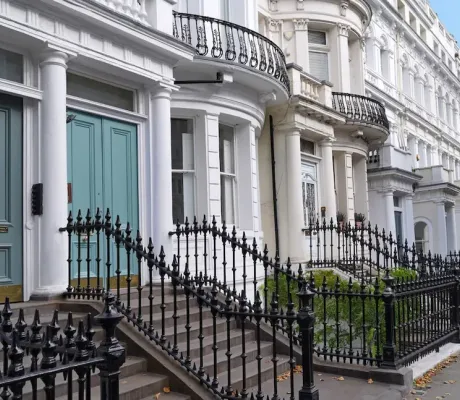
Super prime property is defined by exclusivity, space and location. In London it usually means significant square footage or land in a prime postcode with landmark views and strong transport links, or a country house near an area of outstanding natural beauty.
For a lender, these features make the property harder to value, because comparable sales are few.
Should I buy a super prime property outright or take a mortgage?
Most wealthy buyers who could pay cash still borrow, because the capital can stay invested rather than sit in one property. That is a decision for the buyer and their investment adviser, not a rule, and it carries the risk that the investments fall while the debt does not.
Taking cash out of a business is expensive. One, you lose your working capital in a business that is often used to produce more revenue and more profit. By distributing reserves in a business, the director then has a personal tax cost, dividend tax or PAYE tax. The same goes for liquidating other assets when you factor in taxation, loss of upside, loss of opportunity cost, friction and time. Borrowing is something that should be considered as an alternative.
Tax treatment of borrowing differs by country and by the borrower’s circumstances, and only the buyer’s tax adviser can confirm it. Some borrowers weigh fixed debt against inflation; property values can fall as well as rise, so that judgement is theirs to make with advice.
Where can I source an ultra-high-net-worth mortgage?
Through a specialist mortgage broker with access to the private banks and specialist lenders that serve wealthy borrowers, many of which do not deal with borrowers directly. Enness Global arranges large and complex mortgages for high-net-worth clients from London, Dubai, Jersey, Zurich, Geneva and Nice, with a named adviser on each case from the first conversation to completion.
Going just to their own existing bank is the first mistake. Each bank has its own criteria, rates, policies, processes and exceptions. We work with hundreds and hundreds of lenders, over a thousand. So the chance that the existing bank is the correct bank is actually quite low when you look across the market.
Ask any broker for anonymised case studies of similar transactions; a published example is a circa £4.5 million interest-only mortgage at approximately 90 per cent loan-to-value.
Of the 415 lenders Enness Global’s lender database actively tracks, 72 carry large-loan programmes for high-net-worth borrowers by Enness’s own classification (Enness Lender Database, September 2026). Of the 116 lenders whose residential criteria are tracked from published sources, 66 publish no maximum loan, which is typical of private banks. Terms depend on status, valuation and lender criteria.
What could go differently?
A lender can decline on criteria despite substantial wealth, usually because the income shape or the property is outside its rules; the adviser then takes the case to the next route. The valuer can value the property below the agreed price, which re-sizes the loan; super prime homes are hardest to value because comparable sales are few. A private bank offer can be conditional on moving assets to the bank.
Where income or deposit is in another currency, the lender applies a currency haircut and re-checks affordability before completion. An interest-only loan must have its capital repaid at the end of the term. Borrowing has a cost even with ample liquidity, and property values can fall as well as rise.
What is Enness Global’s CEO and Founder seeing in large mortgages in September 2026?
Islay Robinson: “Cash on account is highly inefficient and not usually something that high-net-worth individuals do. Their cash will be in investments, portfolios, private equity, securities, businesses, trusts and all manner of other instruments, and breaking those structures is very rarely done without friction.”
As of September 2026, we are seeing individuals look for the highest leverage possible against assets, even if that comes with a slight premium in interest rate, because liquidity is a priority. It’s quite unusual for a high-net-worth individual to have all the cash needed to purchase a high value property outright. We often see individuals purchasing in cash for speed, but more often than not there is an immediate refinance, with the equity released and put back into other investments.
Frequently asked questions
Do rich people have mortgages, or do they pay cash?
Both. “For an ultra-high-net-worth individual, a mortgage isn’t a need; it’s one of a number of options available to them to deliver their plans,” says Islay Robinson. The decision turns on what the money would otherwise do, and borrowing carries the risk that the investments fall while the debt does not.
What is an ultra-high-net-worth mortgage and how is it assessed?
A large residential loan structured around a borrower with substantial wealth. Lenders weigh the whole financial position, including income, investments, other property and the repayment strategy, alongside the property’s value, rather than a single affordability multiple. Interest-only structures are common where a credible repayment plan exists. Terms depend on status, valuation and lender criteria.
Which brokers arrange large mortgages for ultra-high-net-worth buyers in the UK?
Specialist brokers with access to private banks, international banks and high street large-loan desks. Enness Global has arranged loans of £1 million and above since 2007, with a named adviser on each case from the first conversation to completion. The lender route follows where your income and wealth sit; terms depend on status, valuation and lender criteria.
Should a wealthy buyer take an interest-only mortgage on a £5 million home?
Some do, to keep monthly commitments low while capital stays invested. Lenders that offer interest-only at this level want a credible repayment strategy for the capital, such as investments, other property or a planned sale, and they assess the whole balance sheet. Whether it suits you depends on your circumstances and advice; terms depend on status, valuation and lender criteria.
Get in the Know
Subscribe to our newsletter
Speak to Enness Global about financing a home you could buy outright; the first conversation covers whether the case can be done, the route and your date. More from Islay Robinson and at islayrobinson.co.uk. Call +44 (0)203 758 9393 or use the contact form.
This article is for general information purposes only and does not constitute financial, investment, tax or legal advice. Tax treatment depends on individual circumstances and may change. Readers should seek appropriate professional advice before making financial or tax-planning decisions.
All lending is subject to individual circumstances, lender criteria, affordability assessments and satisfactory due diligence. Rates, terms and loan-to-value ratios vary between lenders and may change.
Your home may be repossessed if you do not keep up repayments on your mortgage.
Cross-border borrowing may involve additional legal, tax, regulatory and currency considerations, and independent professional advice should be sought where appropriate.
Enness Global is a broker, not a lender.

Related Blog Posts
View All Read MORE
3rd Mar 26 - 8 MIN READ
How Do Ultra-High-Net-Worth Individuals Finance Prime Property Without Selling Assets?
 Read MORE
5th Mar 26 - 10 MIN READ
Private Bank Mortgages: How High-Net-Worth Borrowers Secure £1m-£10m+ Residential Loans
 Read MORE
1st Jul 26 - 9 MIN READ